Thursday, June 9, 2011

My Experience in Tanzania


I just returned from an absolutely amazing journey!  For the past month, I have been teaching pre-school in rural Tanzania. Let's just say, I have an entirely new appreciation for pre-school teachers and love & devotion for my career. The patience, persistence and energy needed to run a pre-school class is incredible.

However, I'm proud of the progress we made with the class throughout May. The children learned all the names of the letters in the alphabet, can write inside the lines, are grasping the concept of writing words vs. individual letters, and much much more!

Additionally, I was a house volunteer to 11 boys and girls aged 4-9 years old.  I helped prepare their meals, got them ready for the day (a few socks always seemed to be missing each morning), walked them to school and read them stories before bed.

Needless to say, this past month has been very far removed from my every day, but it was an incredibly enriching and rewarding experience that I will remember for the rest of my life!  I feel very lucky to have worked with an incredible organization like the Tanzanian Children's Fund.

TCF is an wonderful brand. It is truly devoted to helping develop Tanzania's future through its youth. Beyond the incredible orphanage, which provides an amazing foundation and genuine home for very deserving children, every program they're involved in, from improving the community's school, providing medical clinics, scholarships, etc., all stems from the passion to enrich Tanzania's youth helping them become contributing citizens in the future.  All of this happens instinctually because the brand purpose in seared into their minds, and their hearts, making brand growth and expansion simple.

The strength of the passion behind TCF's brand purpose creates incredible motivation among its volunteers, but more importantly, for its full-time staff, who are working by 5:30am everyday in a remote area in Tanzania with a smile on their face. In fact, one staff member said they wouldn't be as willing to be at work this early if they were back in the US. But she said it's all for the kids, which makes it worth it.

It's statements like these that prove more organizations need to instil genuine purpose to the core of their business to get the best out their people and, therefore, the best out of the brand!  I feel very privileged to have helped such a passionate organization make meaning this past month.


As for Tanzania - WOW - what a naturally breathtaking country, and its people make it even more spectacular. I have never felt so welcomed in any other country. It was magnificent. Sadly, the country is plagued with fundamental challenges of a lack of medical resources, access to education/information and limited exposure to opportunities, especially in rural Tanzania, which stunt the nation's progress forward.  However, Tanzania is filled with opportunity waiting to be tapped, and I believe the innovative thinking to unleash its potential resides in Tanzania.

I say this because of the way they approach using new technologies. Peter, the co-founder of the Children's Village, was explaining Tanzanians' fear towards new technology, as the leaps forward are always so massive.  Essentially, they go from never having a phone to getting one, but then turning around to a mobile phone only a short period after. Or going straight to computers with internet having never seen a typewriter.  This leaves Tanzanians with huge adoption curves, as there is no natural evolution of technology like in developed nations.

This presents something interesting.  Developed nations, who experience the gradual evolution of technologies, tend to think of new technologies in old ways, which slows the process of developing innovative ways to use these new devices/services.  Whereas Tanzanians see the new technology having no old habits, which, I think, makes them more innovative when developing ways to use these technologies. Just look at how they use mobile devices -- with the most basic phones, they see the opportunity in mobility and phone credit, so now they also use their mobile phones as payment devices, which is something that seems to be taking forever to adopt in some developed nations.  So if I wanted to find new ways to maximise my technology I would take it to places like Tanzania to realise its potential.

Additionally, I couldn't help but be amazed how well they come up with ideas to work around their limitations, like recycling (i.e. using Coca-Cola bottles from forever ago to making paper beads to make jewellery) to using solar power, etc. I find their limitations have created a culture looking for function and practicality over wants.  Even with my running, people were amazed I was running for me and not to go somewhere.

So, I believe, it's thinking without old frameworks, while still working within given limitations that create strong innovative thinkers, who could really harness the potential of Tanzania. But like Peter said, "We first need to walk the kids to school".  I feel incredibly privileged to have been able to do that for the past month, and to have experienced an amazing country with beautiful people and incredible potential.

Tuesday, May 24, 2011

Two Years and Counting

Note: Image from Flickr

Two years and twice the fun! Yep, that's right -- I've been blogging about branding for two years now, and I'm still in love with it!

Looking back, what started as an outlet to write about a topic that interests me, has now turned into a personal brand purpose -- to help organizations around the world make meaning and live it everyday!  This purpose has not only fuelled my work professionally, impacting my approach to the projects I work on, but it has also influenced who I am on a daily basis.

I'm continually on the look for organizations that are innovating ways to make meaning and remain true to their promises. Hence, I have fallen in love with TOMS shoes and am currently in Tanzania volunteering for the Tanzanian Children's Fund.  These are two organizations with wonderful purpose and all their actions are geared towards delivering on that promise.

I look forward to seeing where this blog continues to take me, challenging my thinking and pushing me to hunt for brands with real, meaningful purpose at their core.

Thank you so much for reading my blog and for contributing your comments!  Don't be shy -- I'm always looking for more point of views and interesting commentary to add to the content on this site, so comment away!

Thanks again for an amazing two years!

Wednesday, May 18, 2011

Brand = Gut Feeling

Note: Definition from dictionary.com

It's be a while since I've written about the basics of branding. Recently, I began to consider the definition of 'brand' itself, which, then, made me start to think about how brands form their definitions so people know who they are and what they stand for.

According to dictionary.com, a brand is a kind, grade or make as indicated by a stamp or trademark (aka logo).  OK -- so if a brand is a cue to the quality or type of product we're going to purchase and/or associate with, then where do those feelings come from?

The feelings we have towards brands, are based on our interactions with them. And it is these feelings that define the brand.  Therefore, a brand is not the logo or name, nor it is an experience with an organization, as I sometimes hear it defined. Instead, the logo and name are the cues for a brand, which through personal experiences/interactions with the organization/product/service create a gut feeling towards the brand. From here the brand is defined among the general public as people discuss these experiences, using the brand name and logo as their reference point.

It's like Marty Neumeier says, the brand is not what you (the organization) says it is; rather it's what they (the general public) say it is. However, there are always ways to influence a brand's definition, and it starts from within:

Brand Definition Process

A brand cannot be created on its own. Rather, its definition is based on three key phases:

  1. Internal Brand Definition: the brand purpose is established and perpetuated throughout the organization
  2. Brand Delivery: this is where the organization's talent delivers on the brand creating experiences which influence people's gut feelings towards the organization
  3. External Brand Definition: finally, to spread the gospel, people tend to share their experiences/interactions with others influencing the brand is defined to the general public
It's important to note that in this process the external brand definition has the most impact, and ends up being the primary definition for the brand. Therefore, an organization must perfect phases one and two to adequately influence how they want their brand to be defined. To ensure the internal brand message is being effectively communicated externally, it's important to (1) listen and see what's being said about the brand to alter certain initiatives influencing the external perceptions; and (2) run through this process a number of times to ensure the brand is understood internally to influence the external definition. 


Phase 1: Internal Brand Definition

Great brands start with purpose. This is the crazy hairy audacious idea/dream/goal that guides the organization forward. It usually is motivating and clear to its talent so they know how to move forward and deliver on this purpose daily, without being too prescriptive.


Typically the brand purpose is broken down in two parts:

  1. Aspiration: This is the long-term vision/milestone to accomplish the organization's purpose
  2. Truth: This is what the brand does today to reflect its purpose
Brand's like TOMS Shoes, Nike and IKEA have such strong founding values and purpose (One for one; authentic athletic performance and democratic design) that anyone who works for one of these organizations knows what the long-term goal is and are given the exciting task to deliver on the purpose today, which brings us to phase 2...

Phase 2: Brand Delivered

This phase is essential! This is where the perceptions for the brand are established, which goes on to influence the overall brand definition. It's like Steve Jobs says, "The perception about a brand is reality" making it essential for the brand to be built into the culture of the organization so when someone interacts with the brand, a consistent brand experience is being delivered.

I recently read an article (forgive me I have forgot where) and it said that every time Apple goes to create something, the first question asked in the room is, "what's the customer experience".  It's having key questions, like this, that tie to your core brand pillars, which ensure every time a person interacts with a branded touchpoint the experience influences how the brand is defined.

Phase 3: External Brand Definition

It's in this phase where the reputation -- the most dominant definition -- for the brand is established and propagated.  I recently found a couple rather telling stats on Bazzarvoice saying, "The average consumer mentions specific brands over 90 times per week in conversations with friends, family, and co-workers. (Keller Fay, WOMMA, 2010)" and "74 percent are influenced by the opinions of others in their decision to buy the product in the first place. (Manage Smarter, September 2009)".  These tell me there is little room for organizations to falter in delivering an 'on-brand' experience, or they run the risk of negatively impacting the brand's perception, or worse yet, they miss the opportunity to influence the definition at all, because people talk about brands a lot, and to a captive audience to boot! It's when people talk to others that the brand becomes defined and the gut feeling towards an organization is planted.

If this process is done correctly, you know you have successfully defined and delivered on your brand when (1) people choose you over the competition, (2) they are willing to pay a premium to have your products or use your services, and (3) when they keep coming back for more!

Tuesday, May 10, 2011

Off to Tanzania

Today, I'm off for a month long adventure volunteering in Tanzania with the Tanzanian Children's Fund!  I couldn't be more excited, as this is something I've been wanting to do for years.  I feel lucky to have come across this organization, as I greatly appreciate its purpose to create a family dynamic, while providing education to these wonderful children.

Having come from a strong and supportive family and network of friends, I believe establishing a good family dynamic is the foundation that builds confidence, self-worth and an opportunistic outlook on life. 


During my time in Tanzania, I will be helping prepare the children for their day and tuck them in at night. I will, also, be a teacher's aide, tutoring English and Math, along with planning and arranging playtime activities.  Having benefited from an amazing education myself, I'm thrilled to pay it forward by helping with the development and education of these children.  After all, these children represent the future of Africa, where 50% of the population is now under the age of 15!


While I'm away, I have lined up some blog posts to keep you full of content! I hope you stayed tuned, and if I have a chance, I will post some of my adventures and any cool brand experiences or interesting learnings I come across along the way!


See you in a month!

Wednesday, May 4, 2011

People Not Consumers

Note: Image from Flickr

Sometimes we use words so much that they end up feeling meaningless and repetitive.  That's how I feel about the word 'consumer'. I'm tired of referring to people as consumers. For awhile I wasn't sure why, other than the fact that it just seemed impersonal and generic.  So, after some thought on why I feel this way, I've come to this conclusion:

People are more than consumers, and we need to start viewing people in a more all-encompassing manner.

When we look at people as consumers, we only see them as a selling challenge or opportunity. This is a very narrow and bottom-line way of approaching people. Rather, we should be looking at people as people taking note of their intricate and dynamic lives and how they interact within their environment, or with other people in their community, society etc.

I feel taking this perspective is more pertinent than ever before, because, like Umair Haque has noted on several occasions, people are looking for brands that have a point to what they do. People want to see brands contribute something of value that benefits them, society, the environment, and even the future.  People expect the brands they buy to deliver beyond the product and service, contributing to their lives in a meaningful and relevant way.

An example where we can see this, is by looking at daytime TV-- odd I know -- but recently, ABC cancelled All My Children and One Life To Live, leaving them with just one soap opera. In fact, you are hard pressed to find any network to have more than one soap opera. ABC is replacing these programs with shows devoted to cooking, nutrition and health. This change in demand indicates that people want to spend their time where they can receive tangible value, which they can apply to their daily lives. I feel this is the same for brands (companies, products and services).

Brands need to stop thinking in terms of selling challenges (purposeless) and start defining the role it can play in people's lives (establishing and delivering on a purpose).

I like how Nick Kepple-Palmer, from Wolff Olins, writes about how the new way of business is more about collaboration and less about competition. This is about defining the brand's role in people's lives, finding others who share a similar purpose, and extending what the brand delivers to satisfy its role in a relevant way.

In order to do this, we need to look at people more holistically, rather than as selling challenges -- consumers. By looking at people as people, we can consider all aspects of their lives. This allows a brand to see where its purpose fits and what role it can fulfil in a person's life as an individual, community or on a global level.

By looking at people as people, it opens up greater areas of opportunity for the brand to earn its value, innovate, grow and remain relevant into the future.

Tuesday, April 26, 2011

Balancing Luxury with Digital

Note: Image from The Sartorialist

In addition to my love affair with branding, I am crazy about fashion. I have every AmericanVogue from November 1999 to December 2009. That's 10 years worth of Vogue magazines! I can even show you the transition period when Anna Wintour started to put celebrities on the cover rather than models.

Ok, so now you're wondering what does any of this have to do with branding.  Well having been an avid reader, borderline collector, of Vogue  for so many years, I thought it was interesting when I suddenly stopped buying Vogue without even noticing. What was filling the void for my insatiable desire to know what's in and how I should be styling myself for the season? Well...blogs -- The Sartorialist; Garance Dore; The Glamouria; etc.

This is not to say magazines are dead, but it got me thinking about how even luxury fashion brands cannot avoid the rise and influence of digital.  Their apprehension, although lifting slightly, towards digital platforms, like e-commerce and social media, is understandable.  Many brands feel their luxury experience cannot by adequately translated online.  In addition, these platforms democratize the access to information making brands more accessible. This is not ideal for brands whose value is based on exclusivity and rarity.

However, according to Forrester, luxury consumers love technology and tend to be early adopters. They expect luxury brands, whom which they perceive as innovators and trendsetters that, for so many years, have created breathtaking offline experiences, to translate online with high quality rich media experiences that evoke the brand essence, provide unique services and share value-add content.

The need to be online, to remain relevant and modern for its consumers, while maintaining the mystique that drives its brand value creates an interesting challenge. How do luxury brands balance exclusivity with accessibility and rarity with being known?

First, we need to stop looking at digital as a communications channel and see it more as a behaviour. Rather than a 2-dimensional medium to showcase designs and send out one-way messages, digital platforms enable the brand to come to life, interacting with its customers and delivering the brand promise, similar to its offline presence.  For all intents and purposes the two (online and offline) fold into each other.

Second, demand for luxury brands, like I mentioned two weeks ago, is driven by the story/lifestyle behind the brand, more than the product itself.

Lastly, there are three consumer groups who will interact with the brand and, therefore, need to be considered:
  1. Experience Group: This group actively buys luxury products and are considered regular customers, if not already the muse to the designer.  These people are often the early adopters and influencers within the market.  They want to feel special and unique -- after all, they are the "in crowd". This group is looking for a tangible experience where the brand delivers added value beyond the product.
  2. Inspire Group: These people love fashion, but don't buy their entire wardrobe from luxury labels. However, they do look to them for inspiration on what are the upcoming trends, 'it' products, unique ways to style certain looks or the story behind each season's collection. Here they want a more informative experience.
  3. Aspire Group: The aspirational audience longs to be a part of this world. They escape into the brand's story by purchasing its signature fragrance or beauty products. It's important to note that this group may be the future experience group, so they mustn't be completely forgotten. Millennials have a tendency to establish their brand relationships early and when treated right will form an incredible long-term bond with that brand. However, this also works in the reverse.  This group is looking for insider information and an opportunity to be lost in the essence of the brand.
There are few luxury brands who are using digital platforms to their full potential. I think there is still opportunity to create more value-add services/utility through digital technology to deliver the brand. Oscar de la Renta is starting by offering in-store services like styling advice via phone and email, but this could become a much richer experience with all the available technology today.

However, I'm really impressed by Burberry with their live broadcasted fashion shows, Art of the Trench campaign or recent show in Beijing with 3D models where they use digital to create environments that allow consumers to dream and get closer to the essence of the brand.  Dolce & Gabbana are also making a big push to remain modern by using social media to mesh their online and offline worlds together by bringing bloggers into their stores to style the windows, or having live twitter feedback from guests featured during their latest menswear fashion show. Lastly, Karl Lagerfeld, for Chanel, has been doing a fantastic job of leveraging digital to position the brand as an innovator (being one of the first fashion brands I can remember having a mobile app) and creating content for people to become lost in the spirit of Chanel.

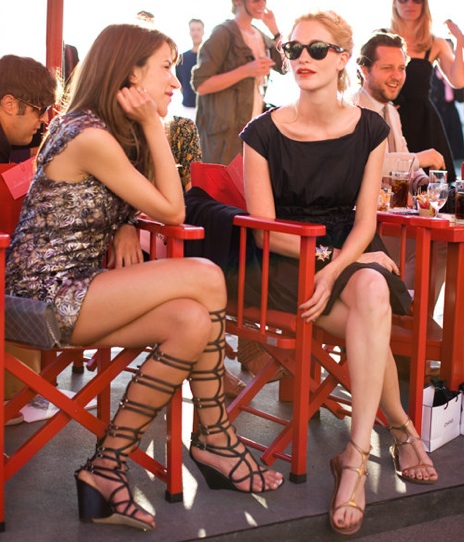
In fact, Chanel did a show, in St. Tropez, for its Spring/Summer '10 collection, where I thought it mastered bringing online and offline together, evoking the brand story and satisfied each group without alienating anyone.

Note: Images from Garance Dore's documentation of the event seen here.

Chanel’s Spring/Summer ’10 fashion show, Croisiere, maintained the balance of exclusive yet accessible. They created a 2-day experience where St. Tropez was transformed into Chanel's world -- how you would live your summer if you truly lived the brand's lifestyle.  Celebrities, socialites, editors, models and muses were all invited. Talk about the ultimate customer appreciation night.

Note: Images from Garance Dore's documentation of the event seen here.

In addition, bloggers, photographers and journalists were invited to document the 2-day experience and share with the general public. This did two things: first it created inspiration on what's in, how to wear it and where to wear it.  Second, having the full lifestyle showcased created the ultimate in aspiration and ability to daydream and escape into the luxurious world of Chanel through blogs, like Garance Dore.

All-in-all, I felt this was a great example of how a fashion label can turn their brand into a tangible entity, bringing the dream to reality and making its core audience feel special and unique, while leveraging digital to extend the impact of the experience in ways suitable for the other audiences.

Today, luxury brands need to find unique and innovative ways to use digital technology to remain relevant and cutting edge to its audiences. Yet, they must do it in a way that balances exclusivity with accessibility and rarity with being known. 

Are there any luxury labels you feel are using digital technology to take their brand to the next level?

Wednesday, April 20, 2011

Is Reebok Living Its Brand?


Last year I wrote about Reebok's brand repositioning, where they began to put greater emphasis on being the sports brand focused on making fitness fun.  Over the past year Reebok saw a 12% increase in sales with a 15% increase in the fourth quarter, which is far better than the state they were in prior to the rebrand.  This double-digit growth is, no doubt, due to their EasyTone and ZigTech product innovations.

Last Friday, I came across an article on Brand Republic talking about the new 'Reebok Trial on Tour' campaign where people can try out the EasyTone and ZigTech shoes in DW gyms and sport stores.  After the people try out the shoes, they can provide feedback on their experience, which will create a great database of consumer insight to hopefully aid the the further refinement of Reebok's products.

A campaign like this not only allows for rich customer feedback as it's in-the-moment (for instance, Gatorade tested horribly in focus groups when it was first being launched, but when tested during a football game it performed extremely well because it was being used in-the-moment it was designed for -- the same goes for this experience), but it also is a great way to raise awareness for Reebok's products. It's personal experiences with brands, like this, that help it to remain top-of-mind for consumers.  However, this personal experience doesn't just create awareness for products, it begins to influence the long-term perceptions towards the brand and what it stands for. The products may change over time, but the perception of what that brand is good at will stick around for years.

This brings me to the reason I'm writing this post: Are trials in gyms the best place for Reebok to be positioning itself?

To ensure they are the leader in helping people become active for the fun of it, rather than being the #1 athlete or smashing personal goals (Nike and Adidas already occupy these areas), Reebok needs to be where people are staying active recreationally.

Having looked on DW Fitness Club's website, I noticed they have group exercise sessions to add a bit of fun to training. I think positioning the Reebok trials during these sessions would be a great start to aligning the brand to fun fitness.

But who's targeting these guys?

The after work ultimate frisbee players:
Note: Image from Flickr here

Or the weekend dodgeball in the park goers:
Note: Image from Flickr here

These are the people who seek fun while staying active. They are also, most likely, the people arranging these activities for their friends. So maybe instead of focusing on gyms -- a place where people go to train and beat personal goals (Adidas) or become #1 (Nike) -- why don't they seek out unique environments that cater specifically to having fun with fitness, like parks, recreation centres or walking paths.

Not only would they be positioning themselves in the minds of their core audience, but they would also be gaining insights for them to further refine and/or create new innovations for people seeking pleasure in fitness rather than just performance.

If Reebok truly wants to be the leader in fun fitness, they need to ensure everything they do, innovate or go to must align with their purpose. This will establish a strong foundation for their year old repositioning. Since it takes a long time to firmly establish what a brand stands for, clarity and consistency around its purpose is key.